TOPIK II · Korean vocabulary

1,469 Korean words, ranked by how often they really show up.

You don't need all 3,000 words. You need the ones that come back. I counted every word in 28 TOPIK II exam papers — 14 reading, 14 listening — and ranked what was left, from the words that appear in nearly every paper down to the ones that only turn up now and then.

Instant download PDF + Excel + Anki One-time payment 14-day refund
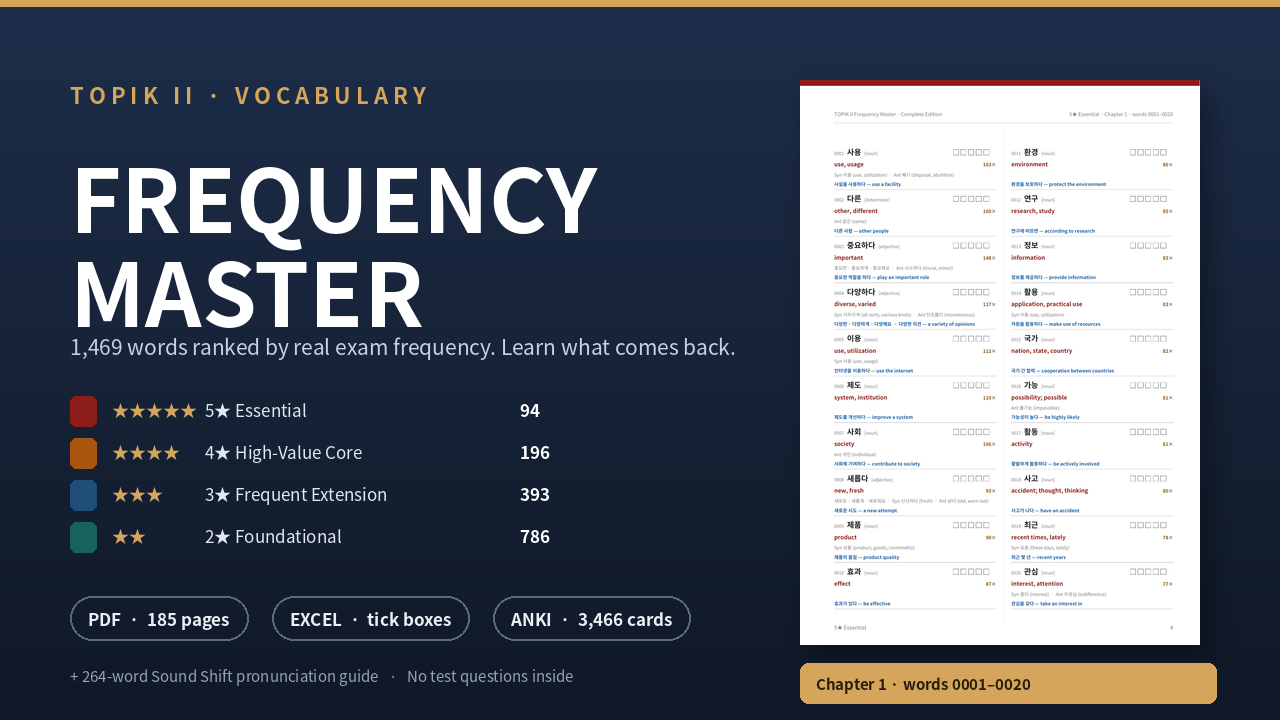
TOPIK II Frequency Master cover: 1,469 words ranked by exam frequency

The problem with vocabulary lists

Alphabetical order tells you nothing about what to study first.

Most TOPIK word lists are sorted by theme, by textbook chapter, or straight down the alphabet. None of that ordering tells you which words are worth your evening. So you spread yourself evenly across thousands of words and meet half of them for the first time in the exam hall.

This is the same vocabulary, sorted a different way: by how often it actually appeared. Work from the top and every hour you spend lands on the words most likely to show up again.

What's inside

One ranked list, and everything you need around it.

1,469 words in four tiers

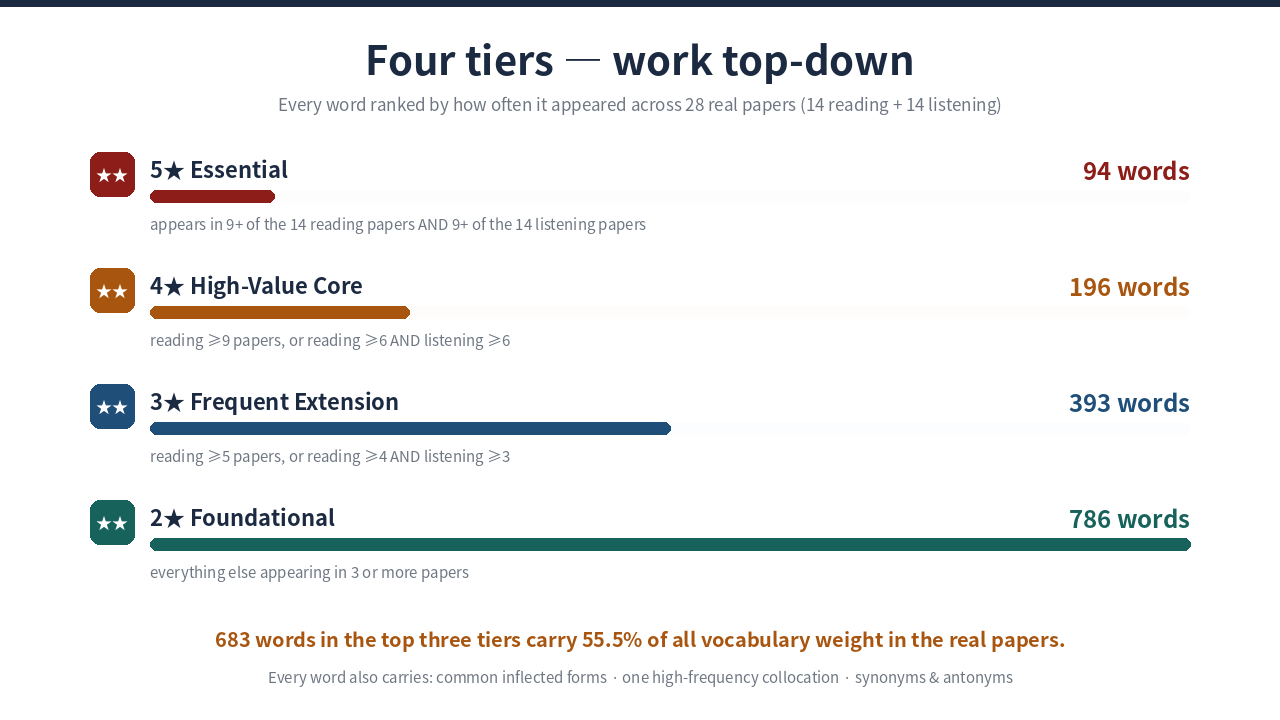
Every word ranked by real exam frequency and sorted into 5★ Essential (94), 4★ High-Value Core (196), 3★ Frequent Extension (393) and 2★ Foundational (786).

Common forms for every verb and adjective

Real texts never use the dictionary form — you meet 새롭다 as 새로운, 새롭게, 새로워요. The three most common shapes sit right beside each word.

One high-frequency collocation per word

The company each word keeps in real Korean — 중요한 역할을 하다, play an important role — so you learn it the way it actually appears.

Synonyms and antonyms, glossed in English

Korean near-equivalents with a short English note, so you widen your vocabulary in place without opening a dictionary.

The Sound Shift Guide — 264 words

Korean doesn't pronounce what it writes. For the words where the gap is widest you get what you actually hear, romanised, plus the chain of sound changes in the order they really happen.

Tracking and self-testing built in

Five tick boxes per word in Excel, a live progress dashboard, and a Spot Check quiz that draws a random batch from any tier — change the seed for a fresh set.

The four tiers: 5-star Essential 94 words, 4-star High-Value Core 196, 3-star Frequent Extension 393, 2-star Foundational 786

Four tiers, so you always know what to do next.

The four tiers

Not all 1,469 words deserve the same effort.

Each tier is a different job. The list is ordered for you: start at tier one and work down.

★★★★★ 94 Essential

Nearly every paper. Learn to write them and use them.

★★★★ 196 High-Value Core

Very common. Learn to write them, no sentences needed.

★★★ 393 Frequent Extension

Recognition is enough. Know them when you meet them.

★★ 786 Foundational

Screen once and tick the ones you didn't already know.

Formats

Paper, spreadsheet, or spaced repetition.

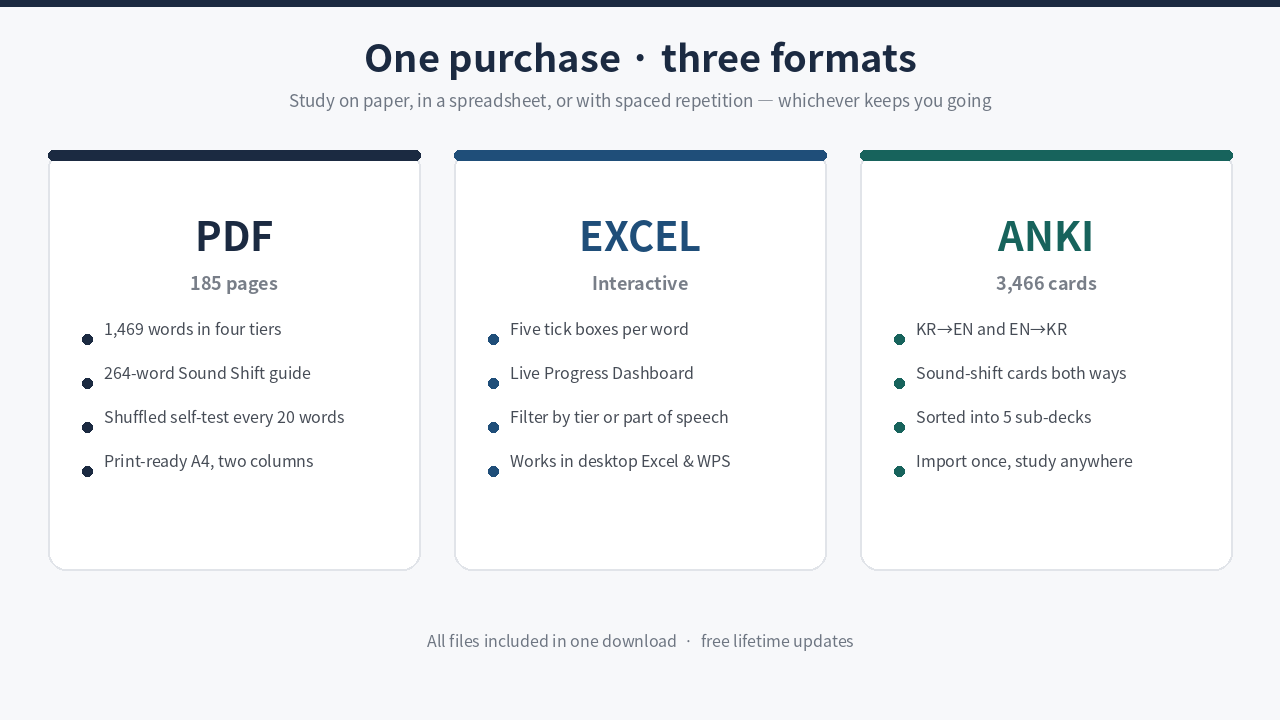
The same 1,469 words, three ways. Use one, or use all three together.

Print-ready PDF

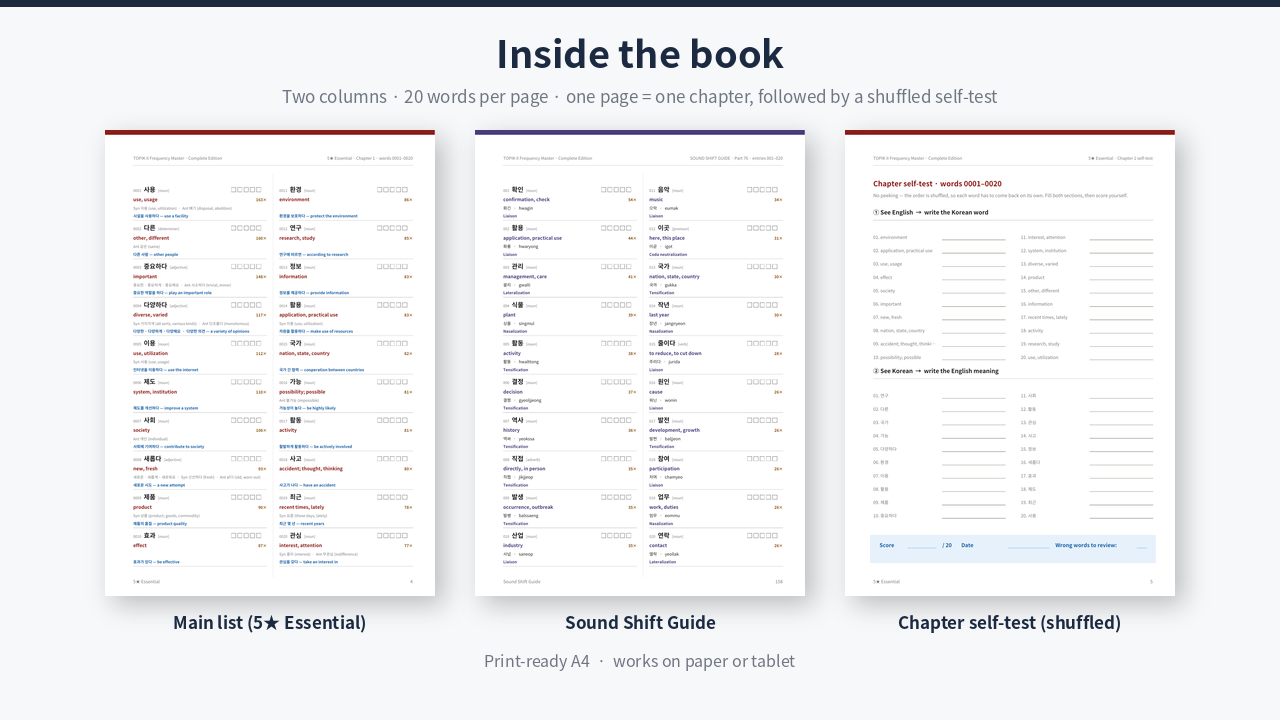
186 pages, A4, two columns. One page is one 20-word chapter, and every chapter ends with a shuffled two-way self-test.

Interactive Excel workbook

Six sheets: how-to, the main list, the sound-shift list, a live progress dashboard, a Spot Check quiz and its hidden word pool. Works in desktop Excel and WPS.

Anki deck

3,466 cards in five sub-decks, Korean → English and English → Korean, including the sound-shift words both ways. Double-click the .apkg to import.

The three formats included: PDF, Excel workbook and Anki deck
A page from the PDF showing 20 ranked words with meanings, common forms and collocations

How to study it

Four tiers, four different methods.

Do not drill all 1,469 words the same way. The full method is in the pack; here it is in short.

5★ Essential — write and use

Five rounds, one box each: spot the shape, lock the meaning, spell it from memory, use its collocation in a sentence of your own, then test full recall. These decide your reading score.

4★ High-Value Core — write, no sentences

Four rounds: meaning, then the three inflected forms, then spell it from the English, then re-test a week later.

3★ Frequent Extension — recognise in context

Two rounds only: read the entry aloud with its collocation, then cover the Korean and check the meaning comes back. No spelling practice.

2★ Foundational — screen, don't study

One pass: scan down and tick only the words you did not already know. Re-draw them weekly in Spot Check, and promote anything that keeps coming back to the 3★ method.

Sound Shift Guide — say them out loud

Written form and spoken form differ: 없이 is read 업씨. Read the "reads as" column aloud, then use the Anki sound deck both ways. These are the words you will hear but would not recognise on paper.

Get the pack

Everything, one payment, instant download.

TOPIK II Frequency Master — Complete Edition

$19 USD, one-time

No subscription. Yours to keep, on all your own devices. Updates to this edition are free.

  • 186-page print-ready PDF (main list + Sound Shift Guide)
  • Interactive Excel workbook with tick boxes, progress dashboard and Spot Check quiz
  • Anki deck — 3,466 cards in five sub-decks
  • START HERE setup guide
  • Full license and disclaimer

Secure checkout by Paddle, our merchant of record — cards, PayPal, Apple Pay and Google Pay. They handle the tax and send your invoice. 14-day refund policy.

Questions

Before you buy

Are TOPIK questions or passages included?

No — and that is deliberate. There are no test questions, no reading or listening passages and no question-number references anywhere in the pack. It is an independent frequency analysis of vocabulary only. That is also why it is safe to keep and share with nobody.

How is this different from a normal TOPIK vocabulary book?

Normal books list words alphabetically or by theme. This one ranks 1,469 words by how often they actually appeared, so every hour you spend lands on the words most likely to come back.

Do I need Anki?

No. The PDF and the Excel workbook stand on their own. The Anki deck is there for people who like spaced repetition, and it is included either way.

Will the tick boxes work on my computer?

They are real form controls, so you need desktop Excel or WPS. Online previews — Google Drive, phone previews, chat apps — will show the columns but no boxes. That is not a damaged file. Everything else in the workbook works everywhere.

Can I print it?

Yes — the PDF is laid out for A4, two columns per page, and prints cleanly in black and white.

I'm a complete beginner. Is this for me?

Honestly, no. Headwords are in dictionary form and the 3★ and 2★ tiers assume you can already read Hangul and handle basic grammar. Come back when you are working towards Level 3.

Can I use it with my class or language academy?

The standard license is for one person. Multi-user licenses for classes are available — email me with the number of students.

What if it isn't right for me?

Email hello@topikfrequency.com within 14 days of purchase and I will refund you in full, no explanation needed. See the refund policy.

How do I get the files?

The moment your payment goes through you land on a download page, and Paddle emails you a receipt that also links back to it. Keep the receipt — it is your license and your proof of purchase.